The Reset Button Doesn’t Exist: Using Sim Racing as Track-Day Homework
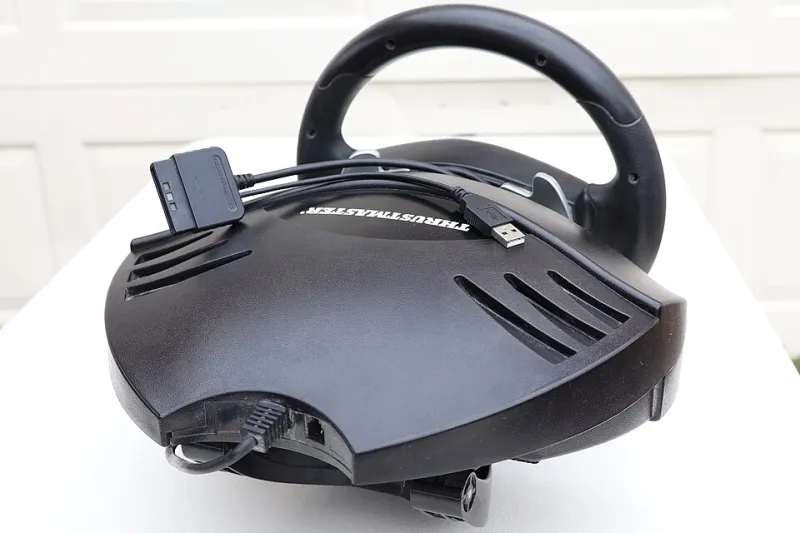
Photo: FreeMediaKid!, CC BY 4.0, via Wikimedia Commons
There is a particular kind of confidence that comes from a spare-room sim rig. You have done a hundred laps of your local circuit on a Tuesday night, your braking points are consistent, and the lap timer says you are quick. Then you arrive at a real airfield circuit in November, the tyres are cold, the wind is doing something unpleasant across the runway, and the first braking marker arrives about three seconds earlier than your thumbs expect.
That gap between the screen and the tarmac is the whole story. Sim racing is genuinely useful preparation for a first track day, but only if you understand what it is teaching you and what it is quietly leaving out. Treat it as homework, not a homologation certificate.
What the rig gets right
The most underrated thing a sim teaches is repetition. Real track time is expensive and brief; a home rig lets you do the same corner fifty times and notice what changes when you move your reference point by a metre. That is valuable. Instructors regularly see novices who have never thought about a braking point in their lives, and sim drivers arrive already fluent in the language of turn-in, apex and track position.
It also builds useful habits: looking ahead rather than at the bonnet, keeping your hands calm, and accepting that a tidy lap is usually faster than a dramatic one. Racecraft is harder to transfer, but the basic discipline of being predictable around other cars does carry over. So does frustration tolerance. A sim session that goes badly teaches you to reset, breathe and go again — which is roughly what a damp track day asks of you by 10am.
The braking-point illusion
Here is the first place the spare room lies to you. In most sims, the car is ready to perform immediately. The tyres are broadly in their window, the brakes are warm, and the grip is consistent from the first corner. On a real British track day, especially at an airfield circuit in spring or autumn, the first two or three laps are a negotiation with cold rubber, damp patches and a surface that has not seen much traffic.
Sim drivers often arrive over-braking because the screen has taught them that the car will stop on demand. Instructors will usually spend the first session dialling that back. The fix is not to brake earlier in the sim; it is to use the sim to learn the shape of the corner, then accept that the real braking point will move. Think of the rig as a map, not a metronome.
Where the sim quietly misleads
The serious omissions are physical. A sim cannot give you the smell of hot brakes, the vibration through the floor, or the way a cold tyre feels through the wheel for the first half-mile. It cannot teach you about noise limits, either. British track days are strict on static and drive-by sound, and a sim has no equivalent. If you turn up with a car that fails the meter, your day ends before it starts — no reset button, just a long drive home.
Then there is consequence. In the sim, a mistake costs you a lap. At a real circuit, an off can cost you a bumper, a recovery fee, an insurance excess and a difficult conversation with the circuit operator. That is not a reason to be frightened, but it is a reason to leave margin. The best sim-trained drivers are not the ones who arrive fastest; they are the ones who understand that the real car has a wallet attached.
Tyre warmth, weather and the British compromise
A cold, damp track day at a place like Bedford or Blyton is a lesson in patience. The sim may let you explore the limit immediately; the real circuit asks you to build up to it. Use the rig to practise smooth inputs and early laps at reduced commitment. If your sim has a realistic tyre-temperature model, use it. If it does not, assume it is flattering you.
Weather is another gap. Sims can render rain, but they rarely capture the specific misery of a British circuit with standing water in one corner and a dry line in another. Club racers will tell you that the first wet track day is mostly about vision and braking earlier than your pride wants. You can rehearse that mentally, but you cannot download it.
A sensible way to use the spare room
Pick one circuit you are actually visiting and run it in a car close to yours. Avoid racing the AI; instead, do steady laps and note reference points. Practise looking through corners and leaving space for error. Treat every session as a chance to build a checklist: seat position, mirror settings, tyre pressures, fuel, noise test, and what you will do if the car does not start. The rig is also a good place to learn flags and briefing basics, even if the physical paddock will still feel unfamiliar.
Instructors tend to spot sim drivers quickly. They brake late, they know the layout, and they are often smoother than they expect. The good ones also listen when told that the real car is not ready to be pushed. That is the difference between preparation and fantasy.
So yes, use the sim. Use it for track knowledge, for repetition, for the discipline of a clean lap. Just remember that the spare-room circuit has no cold tyres, no noise meter and no recovery truck. The reset button is the one thing you cannot pack.