Where the Grid Queues for Grip: A Race Weekend in the Paddock Tyre Bay

Photo: Josh Baumgartner, CC BY-SA 4.0, via Wikimedia Commons
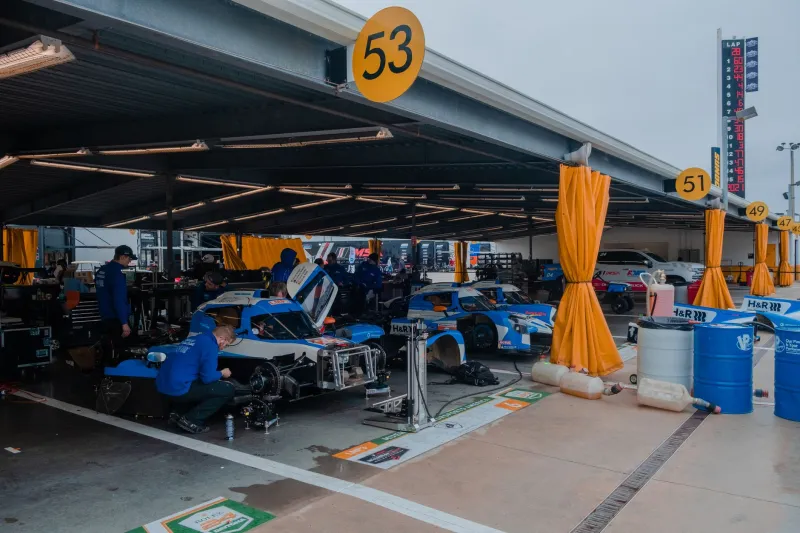
The paddock is still half asleep when the first compressor starts. It is just after seven on a Saturday morning, the sky doing that flat British grey that makes every circuit look like Snetterton in November, and a mobile tyre van has already backed into its usual spot behind the scrutineering bay. Doors open. Wheel boxes come out. A kettle goes on. Within twenty minutes there is a queue.
At a club race meeting, the tyre bay is not a side attraction. It is the paddock’s busiest information exchange, its most honest economics lesson and, on a wet Sunday, its best chance of getting home with a straight car.
The Van That Sets the Pace
A mobile tyre fitter at club level does more than mount rubber. The good ones arrive with a van full of part-worns, a pressure gauge they trust more than the one on your shelf, and an encyclopaedic memory of who was blistering what at the last meeting. They know which Formula Ford runner is chasing a set of wets for Cadwell, which MX-5 driver has a pair of decent scrubbed tyres going spare, and which rookie has just discovered that sticker tyres and a damp Brands Hatch Indy are not a natural pairing.
The queue outside the van is rarely just about fitting. Drivers arrive with wheels in the back of an estate car, a trolley jack rattling beside them, and a question they are slightly embarrassed to ask. What pressures should I start with? Are these take-offs actually any good? Can you tell if this tyre is flat-spotted or just ugly? The fitter looks at the tread, asks what the car weighs, what the class rules allow and what the forecast is doing, and gives an answer that is half science and half paddock folklore.
What a Set Actually Costs
Club racing has a way of making expensive things sound reasonable. A new set of tyres for a competitive club car can run from roughly £500 to well over £1,000 depending on the formula, the compound and whether you are buying from a trackside van or planning ahead. For many racers, that is a significant chunk of the season’s budget — often more than the entry fees, sometimes more than the car is worth in February.
This is where take-offs and part-worns earn their place. Ex-higher-series rubber, scrubbed-in club tyres and carefully stored wets change hands for a fraction of new prices. A decent pair of part-worns might cost £60 to £150; a full set of usable take-offs can be less than a single new slick. They are not a shortcut to pole position. They are a way to do more laps, and at club level laps are the currency that matters.
The tyre bay’s economics are thin. Fitting, balancing, disposal and advice all take time, and the van is not a charity. But the fitter who tells you honestly that your old set has another dry meeting in it, rather than selling you a fresh set you do not need, tends to get the business next time. In a paddock that runs on favours and remembered names, that reputation is worth more than a one-off sale.
Scrubbing In, Not Showing Off
New tyres need a gentle introduction. The mould release compound and the fresh surface mean sticker rubber can feel greasy for a lap or two, and a club racer who leaves the assembly area determined to prove a point usually ends up proving the opposite. The tyre bay version of scrubbing in is simple: heat cycles, sensible laps, no heroics. Let the tyre come to you.
It is also where you hear the best excuses. The car was understeering. The rear was nervous. The brakes were dragging. The fitter nods, checks the pressures, and quietly points out that 32 psi hot in a light car on a cold track is not a setup philosophy. Sometimes the answer is not a new set of tyres. Sometimes it is twelve pounds and a lesson in gauge calibration.
Reading the Rain
Wet weekends separate the tyre bay’s regulars from its tourists. Pressures become a moving target, tread depth matters more than compound stickers, and everyone suddenly wants to know who has a spare set of wets in the back of a Transit. A fitter will tell you that dropping pressures slightly can help the tyre generate heat and put more rubber on the road, but too little is an aquaplaning invitation. The real skill is reading the circuit: where the water is sitting, how fast it is drying, whether the forecast is bluffing.
The tyre bay becomes a weather station with a queue. Drivers compare notes on the exit of the last corner, the fitter compares notes on wear patterns, and someone’s mate who walked the track at dawn becomes briefly the most important person in the paddock.
The Paddock’s Information Exchange
By lunchtime on Saturday, the van has become a noticeboard. A set of wets is sold. A pair of dry tyres is lent to a novice who has flat-spotted his only good set. A debate breaks out about whether a certain compound is worth the extra money for a ten-lap race. The timing screen tells you who is quick; the tyre bay tells you why, or at least offers a theory.
That is the quiet value of the place. Club racing can be insular, especially for newcomers, but the tyre bay is one of the few spots where information moves without a paywall. You do not need a data engineer to learn that your rear pressures are climbing too much. You need someone who has seen the same car, or a very similar one, do the same thing three weekends running.
When It Goes Wrong
Not every visit is routine. Punctures, blistered shoulders and flat-spots from a locked wheel all end up at the van. Sometimes the tyre is scrap; sometimes it can be swapped front to rear and live to fight another day. Disposal is part of the service, and the pile of dead rubber behind the van is a reminder that motorsport’s grip comes with a landfill line item.
Scrutineers and tyre fitters do not always agree on everything, but they share an interest in safe rubber. A tyre that is down to the cords or holding a repair you would not trust on a trailer is not a club racing bargain. It is a black flag waiting to happen.
The Last Lap of the Weekend
By Sunday evening, the van is packing up. Wheels are stacked, the compressor is wound down and the kettle has done its final shift. The timing screens are being folded away, the paddock is full of tired people in waterproofs, and somewhere a driver is loading a set of part-worns into a hatchback with the care of someone handling something far more expensive than it is.
The tyre bay does not get a mention in the race report. It does not need one. Every club grid is built on a quiet chain of pressure checks, scrubbed-in rubber and honest advice from someone who has seen it all before. Black gold? Maybe. Mostly it is just black rubber, blistered hands and the busiest queue in the paddock.